AI can produce answers that sound authoritative, arrive in seconds, and look perfectly formatted. That speed creates a dangerous illusion: if the output is fluent, many teams assume it is correct.
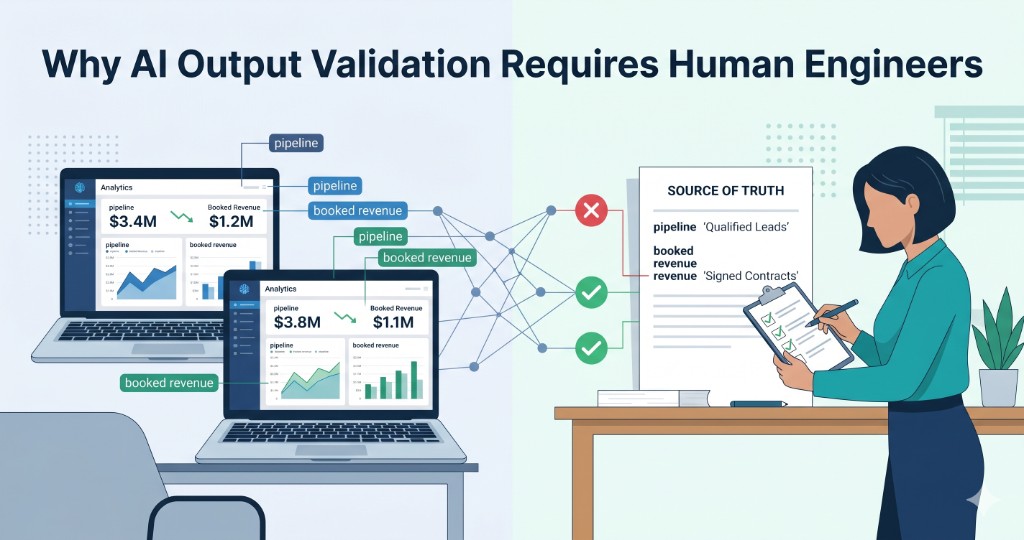
In practice, two experienced people can ask the same question of the same AI system and receive different answers. Not slightly different wording — different numbers, different conclusions, and different recommendations. When those outputs drive revenue forecasts, pricing decisions, or board-level strategy, "close enough" is not enough.
The organizations that scale AI responsibly are not the ones that deploy the fastest. They are the ones that build a validation layer — human engineers, analysts, and domain experts who treat AI output as a draft that must be verified before it becomes a decision.
This discipline will grow, not shrink, as AI becomes embedded in daily operations.
The problem is not AI enthusiasm — it is unverified certainty
Most executive teams are under pressure to show AI progress. That pressure pushes teams toward visible activity: more copilots, more agents, more automated reports. Less visible but more important is the control layer: who verifies outputs, against what source of truth, and with what accountability when something is wrong.
Without that layer, AI does not reduce risk. It relocates risk — from "we did not have an answer" to "we acted on an answer that looked right."
Same question, different answer: why this happens
Non-determinism is only part of the story. Even when temperature settings are low, outputs can diverge because:
- Prompt context differs: small changes in phrasing, uploaded files, or prior chat turns change what the model prioritizes
- Retrieval variance: in RAG systems, chunk ranking and embedding matches can shift between queries, so the model reasons over a different evidence set
- Tool and data snapshots: if AI pulls from live warehouses, CRMs, or spreadsheets, the underlying data may have changed between two users or two minutes
- Model and policy updates: provider updates, safety filters, and routing across model versions change behavior over time
- Implicit assumptions: the model fills gaps when business definitions are underspecified (for example, "revenue" without clarifying booked vs recognized vs collected)
Leaders should assume variation by default. The operational question is not "how do we eliminate variation?" It is "how do we detect and contain incorrect variation before it reaches decisions?"
Case pattern: sales data and the semantic layer gap
One of the most expensive failure modes is confident analysis built on a weak semantic foundation.
Consider a common scenario: a revenue leader asks AI to analyze pipeline health by segment for the quarter. The system returns a crisp summary — conversion rates, stage aging, win probabilities, and a list of "at-risk" deals. The narrative is compelling. The chart is clean. The meeting moves forward.
Then finance joins and asks a basic definitional question: are we using CRM stage dates or finance booking dates? Are expansions included in new business? Are churned accounts excluded from active pipeline denominators?
Suddenly the numbers do not reconcile. The AI was not "hallucinating" in the cartoon sense. It was answering using a definition that was close to the business language but not identical to the company's semantic layer. The result was plausible, near-correct, and still wrong.
This is where many teams get hurt:
- The output is close enough to pass a quick glance
- The error is semantic, not syntactic — so it is harder to spot
- The damage appears later, when decisions and forecasts are built on mismatched definitions
- Trust erodes across functions because each team has a different version of "truth"
Semantic alignment is not a data engineering side quest. It is a core requirement for AI reliability in revenue, finance, product, and operations.
More examples leaders should recognize early
Customer support and policy interpretation
Two support leads ask AI whether a refund is allowed under policy. They receive different answers because one prompt references the public FAQ and the other references an older internal macro. Both answers sound policy-compliant. Only one matches the current legal-approved rule set.
Procurement and contract comparison
AI summarizes renewal terms across vendors. One summary treats auto-renew as "standard" while another flags a 90-day notice trap clause. The difference is not model intelligence — it is which document version and clause hierarchy were in scope.
Engineering and incident analysis
AI correlates logs and suggests a root cause. Two on-call engineers run similar prompts and get different causal chains. If the team closes the incident without validating against telemetry and change records, they risk fixing the wrong problem while the real defect persists.
People and performance analytics
AI generates team productivity rankings from activity signals. Without validation against role context (onboarding, part-time scope, platform migration), leaders may reward noise instead of outcomes and create fairness and compliance issues.
The pattern is consistent: AI accelerates interpretation, but interpretation still requires domain grounding.
Why "human engineers" are becoming a critical role
The phrase "human in the loop" is often reduced to a final approval click. That is too weak for high-stakes workflows.
What high-performing teams are building is closer to human engineers of AI output — people responsible for designing, running, and improving validation systems around AI. Their job is not to slow innovation. It is to make innovation durable.
These roles typically combine:
- Domain expertise: understanding how metrics are defined and used in real decisions
- Systems thinking: mapping where AI touches data pipelines, tools, and workflows
- Test design: creating repeatable checks, golden questions, and expected output boundaries
- Failure analysis: documenting near-misses and turning them into guardrails
- Cross-functional translation: aligning product, data, legal, and business on what "correct" means
This function can sit in data, operations, risk, or product — but it must have authority to stop or qualify outputs that fail validation criteria.
A practical validation operating model
Use a tiered model so validation effort matches decision impact.
Tier 1 — Informational (low risk)
Drafts, brainstorming, internal summaries. Validation: lightweight spot checks and source citations where available.
Tier 2 — Operational (medium risk)
Workflow assistance, ticket triage, standard reporting. Validation: definition checks, sample reconciliation, and periodic audit against source systems.
Tier 3 — Decision-critical (high risk)
Forecasting, pricing, staffing, compliance-sensitive actions. Validation: mandatory human sign-off, dual review for material outputs, and blocked automation unless checks pass.
Tier 4 — External or regulated (highest risk)
Customer commitments, financial disclosures, legal positions. Validation: specialist review, documented evidence trail, and explicit accountability mapping.
Most organizations over-automate Tier 3 and 4 because the demo worked in Tier 1. The fix is not less AI. It is clearer tier boundaries.
Seven validation controls that actually work
- Golden question sets: maintain a standard library of business-critical prompts with expected ranges, required fields, and known edge cases
- Definition registry: publish metric definitions (numerator, denominator, exclusions, timing) and require AI workflows to reference them explicitly
- Dual-run checks: run material queries twice with independent context windows or reviewers; investigate divergence before publishing
- Source traceability: require links to underlying tables, documents, or query logic for any number used in leadership reports
- Reconciliation thresholds: set tolerance bands (for example, +/- 2%) and auto-flag outputs that exceed them
- Change logs for prompts and models: treat prompt and model changes like code releases with version history and rollback
- Near-miss reviews: weekly review of "almost wrong" outputs that were caught late; convert each into a control
How executives should govern this in 2026 and beyond
Boards and leadership teams should ask four questions in every AI initiative review:
- What decision does this output influence?
- What is our source of truth and who owns definitions?
- Who validates outputs before action, and how fast can we detect error?
- What happens when AI is wrong — how do we correct, communicate, and learn?
These questions connect directly to liability, accountability, and compliance — topics that deserve their own operating playbook. A follow-up article will cover decision ownership when AI is involved: who is liable, how to document human judgment, and how to protect the business against costly errors.
Metrics that prove your validation layer is working
- Validation coverage rate: percentage of Tier 3/4 outputs with documented human review
- Reconciliation pass rate: share of AI-generated metrics within tolerance against source systems
- Defect escape rate: incorrect AI-informed decisions discovered after action
- Time-to-detect: median hours from output generation to error detection
- Semantic incident count: number of definition-mismatch events per month
- Rework cost: hours spent correcting decisions based on invalid AI outputs
Improving these metrics is a better signal of AI maturity than counting prompts per employee.
What good looks like in a real weekly cadence
A practical rhythm for leadership teams:
- Monday: review prior week's AI validation incidents and assign control owners
- Wednesday: run golden question tests on critical workflows after any model or prompt change
- Friday: reconcile top AI-generated KPIs used in executive reporting against finance/ops source reports
Keep the cadence short and consistent. Validation culture compounds when it is operational, not episodic.
Quick answers leaders ask
Should we slow down AI adoption to add validation?
No. Add validation in parallel. Slowing adoption creates shadow AI use. Building controls creates trusted scale.
Can automation validate automation?
Partially. Automated checks are essential for scale, but high-impact decisions still need human domain judgment. The goal is augmented validation, not blind trust.
How do we avoid validation becoming bureaucracy?
Tier the controls. Light process for low-risk use cases, strict process only where error cost is high. Publish clear criteria so teams know what is required.
Who should own AI output quality?
Shared ownership: data defines truth, domain teams define acceptable ranges, and a designated validation lead coordinates controls and incident learning.
Final thought
AI will keep getting faster. That is certain. What is not guaranteed is that faster answers will be right answers for your business context.
The competitive advantage is shifting from "who uses AI" to "who verifies AI reliably at scale." Human engineers of AI output — people who understand both the technology and the business semantics — are becoming as important as the models themselves.
Build that layer now, while your AI footprint is still manageable. It is far easier to institutionalize validation early than to rebuild trust after a high-visibility decision fails.
Next in this series: legal and compliance implications of AI-assisted decisions — who is accountable, where liability sits, and how to protect the organization when AI gets it wrong.
One clear email each Thursday
Actionable frameworks on AI execution, agents, and MCP. Join 4,200+ builders.
Leave a comment
Be the first to share your thoughts.