Most AI strategies fail for one predictable reason: they start with tools, not workflows.
When leadership teams anchor on vendor demos before operating priorities, they create fragmented pilots with unclear impact and hidden cost. The result is activity without economic value.
A better framing is simple: AI is an investment decision. If we invest, we should expect measurable returns in speed, cost, revenue quality, or margin. Otherwise, it is experimentation, not strategy.
Why workflow-first matters
Executives do not buy AI. They buy better business outcomes.
That means the right unit of analysis is the workflow: quote-to-cash, support resolution, onboarding, campaign creation, proposal generation, product discovery, internal reporting, and so on.
Each workflow has known friction: delay, handoff loss, quality defects, rework, and labor cost. AI should target those points first.
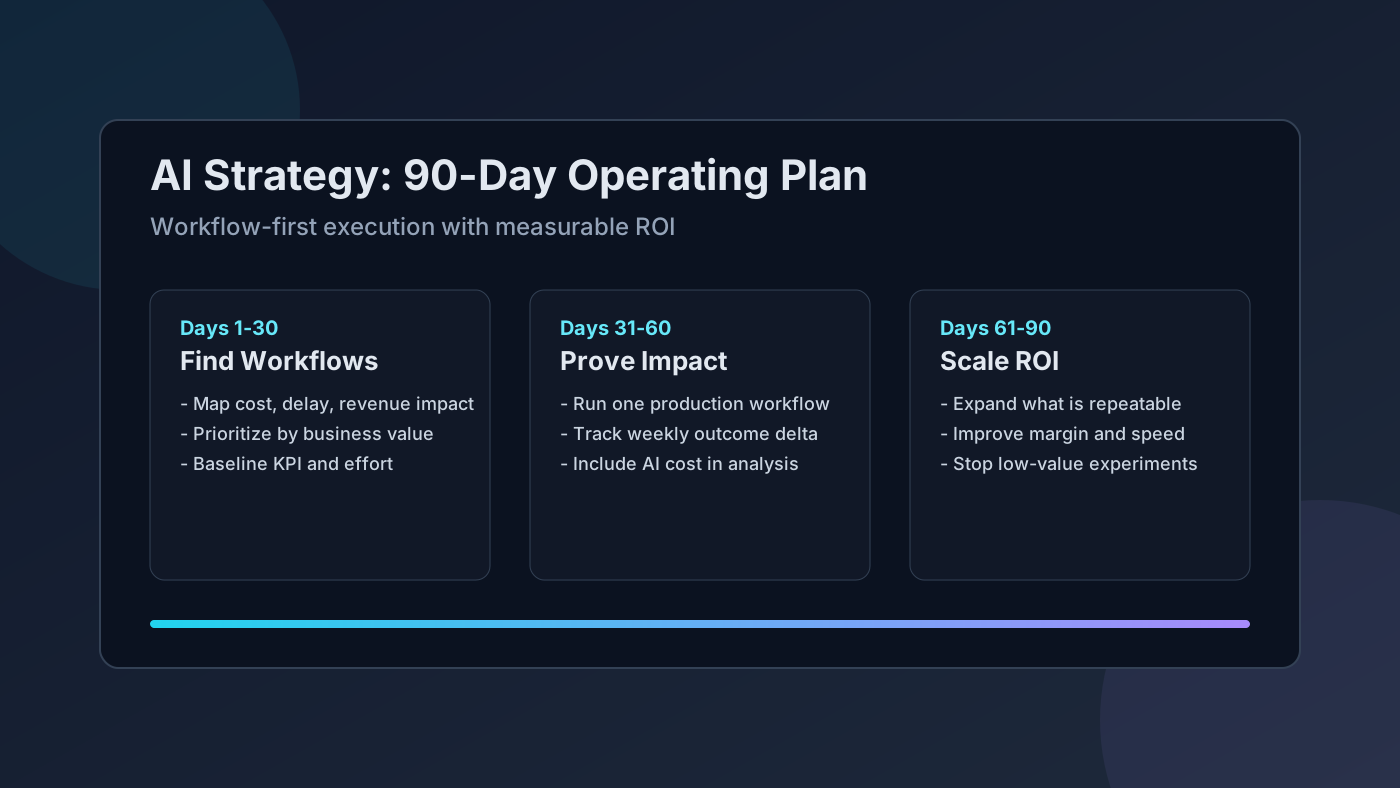
A practical 90-day model
Days 1-30: Find high-value workflows
- Map top workflows by business impact: cost load, cycle time, conversion/revenue influence, and quality risk.
- Score each workflow by value potential x implementation feasibility.
- Select 2-3 candidates, then commit to one primary use case for production delivery.
- Define baseline metrics before any build starts.
At this stage, success is not adoption. Success is choosing the right battle.
Days 31-60: Prove value in production
- Ship one end-to-end workflow, not five disconnected pilots.
- Assign one accountable owner for outcome and economics.
- Track weekly movement in cycle time, output quality, exception rate, and throughput.
- Track AI cost explicitly: model/API spend, tooling licenses, integration effort, and supervision overhead.
You are not proving that AI can work. You are proving this workflow can create net business value.
Days 61-90: Scale only what is repeatable
- Standardize governance, prompts/playbooks, and quality controls for proven workflows.
- Train managers on workflow redesign and role changes, not only tool usage.
- Expand to adjacent workflows only when the first use case shows stable ROI.
- Stop or redesign initiatives with weak economics.
Scale should follow evidence, not enthusiasm.
ROI is non-negotiable
AI always has a cost. Even when productivity improves, you need to convert productivity into measurable business value.
Use a simple model:
ROI = (Annualized Value Created - Annualized AI Cost) / Annualized AI Cost
Where value created can come from:
- Cost reduction: fewer manual hours, reduced rework, lower error handling
- Speed gains: faster turnaround that increases capacity and shortens revenue cycles
- Revenue lift: higher conversion, better retention, increased expansion opportunities
- Quality gains: fewer defects, stronger consistency, reduced risk exposure
And AI cost includes:
- Model/API usage
- Tooling and platform licenses
- Engineering and integration effort
- Ongoing supervision and governance time
From productivity to economic impact
Many teams stop at "we saved hours." That is not enough.
Executives should ask: where did those hours go? Did we reduce cost, increase output, improve service levels, or unlock growth? Productivity only matters when it translates into business outcomes.
Leadership mistakes to avoid
- Optimizing for demo quality instead of workflow outcomes
- Ignoring full cost-to-serve for AI-enabled processes
- Running too many pilots without clear ownership
- Treating adoption metrics as success metrics
- Failing to define stop criteria for underperforming use cases
Executive scorecard for weekly reviews
- Which workflow are we improving, and why this one?
- What KPI moved this week (cost, speed, revenue, quality)?
- What was AI run cost and total operating cost?
- What is current ROI trend versus baseline?
- What decision do we make now: scale, refine, or stop?
AI is not a side project. It is an operating model upgrade with financial accountability. The companies that win will be the ones that connect workflow improvement to measurable, profitable outcomes.
One clear email each Thursday
Actionable frameworks on AI execution, agents, and MCP. Join 4,200+ builders.
Leave a comment
Be the first to share your thoughts.